About Ain
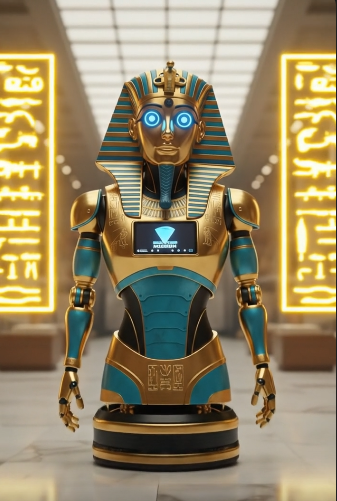
Ain is a Pharaonic-inspired smart museum guide robot that brings ancient Egyptian culture to life using AI storytelling, interactive vision, and immersive experiences.
Vision & Mission
Vision: To unite the timeless wisdom of ancient Egypt with the limitless potential of artificial intelligence. We imagine museums as living experiences — where the past can speak, teach, and interact with every visitor.
Ain, our Pharaonic-inspired AI robot, represents a bridge between civilizations: a digital descendant of ancient scribes and storytellers, reborn to preserve knowledge in a modern form. Through advanced robotics, computer vision, and natural language understanding, Ain turns cultural exploration into intelligent interaction, allowing technology to honor history while inspiring future generations.
Mission: To develop Ain as an intelligent museum guide that embodies Pharaonic heritage while showcasing modern AI’s capabilities — combining education, immersive storytelling, accessibility, and secure connectivity. Ain is designed to transform traditional museum visits into interactive journeys capable of recognizing artifacts through computer vision, narrating their stories with lifelike speech, and engaging visitors in natural, meaningful conversations.
Why This Project?
Museums often lack interactive and personalized guides, causing passive experiences. Cultural storytelling is fading; visitors retain little after a visit. Ain addresses these gaps by offering contextual, adaptive narration, multilingual accessibility, and gamified learning.
Accessibility & Inclusivity
Ain provides voice guidance, subtitles, sign-language animations, and gesture controls — ensuring visitors with hearing or visual impairments can fully participate.
Problem Statement & Challenges
Lack of Interactivity
Static labels and scheduled tours fail to adapt to individual curiosity and pace.
Limited Cultural Preservation
Human guides cannot cover every exhibit; recorded audio lacks personalization and emotion.
Engagement & Learning
Younger audiences struggle to stay engaged; visitors retain little post-visit.
Accessibility Concerns
Many museums lack systems for visually- or hearing-impaired visitors.
Technology Gaps & Costs
AI solutions are less available in some regions; hiring human guides is expensive and inconsistent.
Knowledge Gaps
Artifacts often lack context — preventing meaningful visitor understanding.
Visitor Guidance Challenges
Traditional signage and guides often fail to personalize information for different visitor interests and ages.
Engagement Analytics Missing
Museums lack feedback systems to analyze visitor engagement and improve interactive experiences.
Ain — Key Features & Innovation
AI Vision & Artifact Recognition
TensorFlow + OpenCV models identify statues and artifacts and fetch contextual content from a knowledge base.
Autonomous Navigation
Indoor GPS, ArUco markers, encoders and obstacle detection enable adaptive route planning and safe movement.
NLP & Adaptive Dialogue
NLP tailors answers by age and curiosity; responses are generated dynamically instead of being scripted.
Immersive Display
Projector + 3D viewer reconstructions present historical scenes with interactive overlays and touch interactions.
Multilingual & Accessible
Multiple languages, sign-language animations, captions, and voice guidance support diverse visitors.
Gamified Learning & Social Share
Quizzes, certificates, commemorative photos, and social media sharing boost retention and outreach.
Adaptive Learning Analytics
Analyzes visitor interactions in real-time to personalize the tour and improve engagement.
Immersive Historical Storytelling
Integrates interactive narratives and 3D reconstructions to make history come alive for visitors.
Latest Advances & Ain's Edge
🏛️ Traditional Museums
Before Ain, museum visits relied on static displays, printed labels, or prerecorded guides. Visitors received the same information regardless of age, interest, or pace. Accessibility and multilingual support were limited, and engagement for younger audiences often fell short.
- Surface-level experience; little interaction.
- No personalized content or dynamic guidance.
- Limited support for visually or hearing-impaired visitors.
- Educational impact was shallow and passive.
- No analytics for understanding visitor engagement.
🤖 Ain — The Smart Museum Future
Ain transforms museum experiences into interactive, personalized, and culturally immersive journeys. By combining AI, computer vision, NLP, and AR, Ain recognizes artifacts, narrates their stories, and adapts to each visitor’s curiosity and emotional state.
- Artifact Recognition: AI vision identifies statues and artifacts in real-time, fetching contextual knowledge instantly.
- Emotion & Context Awareness: Adjusts storytelling tone, pace, and content according to visitor reactions.
- Immersive AR Experiences: Step inside historical scenes with interactive 3D overlays and touch engagement.
- Continuous Learning: Visitor interactions feed the system for smarter guidance and personalized recommendations.
- Inclusive Access: Multiple languages, sign-language animations, captions, and voice guidance ensure accessibility.
- Gamification & Social Sharing: Quizzes, certificates, commemorative photos, and social media sharing enhance retention and engagement.
- Analytics & Insights: Track visitor engagement with exhibits to continuously improve experiences.
| Feature | Traditional Museums | Ain (Smart Future) |
|---|---|---|
| Interactivity | Limited & Static | Dynamic & Personalized |
| Content | General for all visitors | Tailored to interests & curiosity |
| Accessibility | Limited languages & aids | Multilingual, inclusive, fully accessible |
| Learning Experience | Passive & surface-level | Immersive & interactive |
| Feedback & Analytics | None | Integrated visitor tracking & insights |
| Technology | Basic & scripted | Advanced AI, AR, NLP, CV |
Technical Architecture & System Overview
Ain is structured into three integrated subsystems: Hardware, Software & AI, and Navigation & Communication. The design emphasizes modularity, scalability, and secure, real-time operation, leveraging modern AI stacks, IoT standards, and upgradeable hardware.
Hardware
- Raspberry Pi 4 or Jetson Nano as the main processing gateway
- High-resolution camera for artifact recognition and tracking
- Motors, encoders, and ultrasonic/IR sensors for autonomous navigation
- Touchscreen, projector, audio system, and battery/power management modules
Software & AI
- Frontend: React.js + 3D viewer for interactive touchscreen UI
- Backend: Node.js + Express with REST & WebSocket APIs
- Vision & NLP: TensorFlow / OpenCV for recognition, Dialogflow / OpenAI for conversational AI
- Data: MongoDB / PostgreSQL for analytics, logs, and visitor insights
- Messaging: MQTT over SSL/TLS ensuring secure real-time communication
System Workflow
The Ain guide follows a smooth, automated process combining autonomous navigation, AI-driven interaction, and visitor engagement:
- Robot powers up and connects securely to the museum network.
- Exhibit route map loads and path planning begins for the selected tour.
- Robot navigates to an exhibit; high-precision camera validates artifacts using AI vision models.
- Interactive narration plays with visuals; visitors engage via chatbot or touchscreen.
- Visitor interactions are logged for analytics, insights, and model improvement.
- Robot proceeds to the next exhibit or awaits further visitor instruction.